
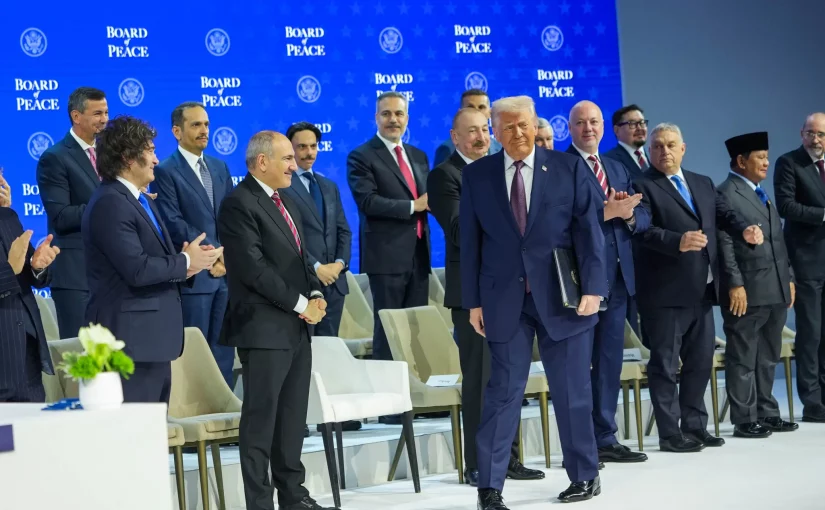
The Board of Peace (BoP) is set to hold its inaugural meeting in Washington, DC, on February 19. The meeting’s announced objective is to bring together leaders of member nations and board representatives to raise funds for Gaza’s reconstruction and advance the implementation of the next phase of the Gaza peace plan. First introduced by President Donald Trump in September 2025, the BoP was initially proposed as an international forum aimed at ending wars and promoting global peace. It began as part of a U.S.-mediated effort to resolve the Israel–Hamas conflict and aid in Gaza’s reconstruction but has since expanded its scope.
Officially, the BoP is an international organization established through a U.S. political initiative and recognized by UN Security Council Resolution 2803 in November 2025. This resolution “welcomes” the BoP’s establishment to support Gaza’s reconstruction. However, the BoP’s charter, signed at the World Economic Forum in Davos on January 22, 2026, extends its mission beyond Gaza. The charter tasks the BoP with promoting stability, restoring lawful governance, and securing lasting peace in conflict-affected regions, adhering to international law without geographic limitations.
The BoP charter outlines a centralized governance structure:
-Chairman: Donald J. Trump is named as the inaugural Chairman, a role independent of his U.S. presidency, with no specified term limit. This allows for the potential retention of the position beyond 2028.
-Executive Authority: The Chairman holds broad unilateral powers, including the ability to invite, approve, suspend, or remove member states, veto all board decisions, interpret the charter, create or dissolve subsidiary entities, and appoint a successor.
-Membership: Only states invited by the Chairman can join. Member states are represented by their head of state or government and serve three-year renewable terms. Permanent membership can be secured by contributing approximately $1 billion.
These structural choices make the BoP’s governance model unusual among international organizations, with power concentrated in a single individual rather than distributed among multiple stakeholders.
As of early 2026, the BoP has attracted participation from countries aligned with U.S. policy interests, including Argentina, Bahrain, Egypt, Indonesia, Israel, Jordan, Kazakhstan, Morocco, Pakistan, Qatar, Saudi Arabia, Turkey, the UAE, and Uzbekistan. However, many traditional U.S. allies and key global powers have not joined or have expressed reservations:
-France and the United Kingdom have declined invitations to join.
-Germany, Italy, Norway, Sweden, Denmark, and Slovenia have either rejected the initiative or shown strong reservations.
-China and Russia have not publicly committed to participation, reflecting diplomatic caution toward initiatives that might sideline existing multilateral structures.
This uneven reception highlights that while the BoP’s membership spans geopolitical divides, it lacks robust support from major Western powers typically involved in global peacemaking.
The United Nations Security Council (UNSC) remains the primary body for authorizing peace and security operations, with its five permanent members—the United States, China, France, Russia, and the United Kingdom—holding veto power over substantive decisions. Their positions on the BoP are as follows:
-China: Abstained on the Security Council resolution welcoming the BoP, citing concerns about insufficient detail on structure and membership, and has not joined the board.
-Russia: Also abstained on the resolution, warning it might transfer too much control over Gaza to the BoP, and has not publicly committed to board membership.
-France: Strongly supportive of UN-centered processes, France has declined to join and criticized the initiative as potentially undermining the United Nations.
-United Kingdom: The UK has stepped back from participation, expressing concerns about legitimacy and the board’s relationship to existing global institutions.
The U.S. is centrally positioned in the initiative, serving as its convener and host. The BoP distinguishes itself from traditional multilateral systems in several ways:
-It does not possess the legal authority of the Security Council under the UN Charter, such as mandating binding peacekeeping or imposing sanctions.
-Its charter does not specifically reference Gaza, despite originating from a Gaza ceasefire plan, and instead outlines a global peace-building mandate.
-The BoP relies on voluntary funding and the political will of participating states, rather than the binding obligations that underpin UN decisions.